 Will Hubbard
Bryan Johnson on a budget
I’ve been involved in the longevity community for a long time, and people constantly ask me what I do for my health: what supplements I take, what devices I buy, which tests are worth it. I used to send them to The Longevity Guide, where I curated my research, but now you can just ask Claude or ChatGPT about the latest evidence on almost anything.
So I figured it was time to finally write down everything I do and what it all costs.
The obvious comparison is Bryan Johnson, who spends about $2 million a year on his body. He has a team of doctors, takes more than 100 pills a day, and has built his whole life around the protocol. I’m a fan of his and respect the commitment, but it isn’t realistic for basically anyone else.
I think you can get most of the way there for well under 1% of that. The biggest wins in longevity are cheap and pretty boring, and a lot of them are things most people still aren’t doing.
I’m not a doctor, and this isn’t medical advice. A few things here are prescription drugs. Talk to your doctor before starting or stopping anything.
Everything I do and what it costs
Here’s my whole stack and what each thing costs out of pocket. You don’t need all of it, and you can hover over or tap any label in the last column to see why I rated it that way.
| What | Cost | Need it? |
|---|---|---|
| Everyday | ||
| Exercise: cardio, strength training, and walking | Free | Core |
| Diet: whole foods, close to Mediterranean, mostly from the farmers market | Varies | Core |
| Sleep: 7+ hours in a dark, quiet, cool bedroom | Free | Core |
| Meditation (Oak, Apple Mindfulness) | Free | Recommended |
| Medications | ||
| Tirzepatide, 5 mg a week | About $400/month, often covered by insurance | Depends |
| Rosuvastatin, 10 mg a day | A few dollars a month, often covered by insurance | Depends |
| Mineral sunscreen (Pipette, Blue Lizard, EltaMD) | About $100/year | Recommended |
| Supplements | ||
| Thorne Creatine, 5 g a day | About $15/month | Recommended |
| Naked Whey protein powder | About $25/month | Recommended |
| Other supplements: vitamin D3, magnesium glycinate, omega-3, and B12 Folate | About $45/month total | Depends |
| Tests and scans | ||
| Blood testing twice a year (Superpower or Function Health) | About $300/year | Core |
| Coronary calcium scan every 5 years | $100 to $200 a scan | Recommended |
| Full-body MRI every 1 to 2 years (Ezra or Prenuvo) | $899 to $2,500 a scan | Optional |
| DEXA scan twice a year (BodySpec) | About $45 a scan | Optional |
| Hearing test with AirPods Pro | Free with AirPods Pro | Recommended |
| Whole-genome sequencing (Genome Computer) | $499, one-time | Optional |
| Devices | ||
| Apple Watch Series 12 | $399, one-time | Recommended |
| Eight Sleep | About $2,650, one-time, plus $199/year | Optional |
| Withings blood pressure cuff | About $130, one-time | Core |
| Withings smart scale | About $100, one-time | Core |
| Air purifiers (Blueair and Molekule) | About $350 each, one-time, plus filters | Recommended |
| Fully standing desk | About $900 to $1,300, one-time | Optional |
| Levels continuous glucose monitor, for a few months | About $200/month while you wear it | Optional |
| One Drop glucose meter for spot checks | About $50, one-time, plus test strips | Optional |
| Doctors | ||
| Health insurance | Varies | Core |
| Yearly checkup with a primary care doctor (One Medical) | $199/year, or $99 with Prime | Core |
| Standard cancer screenings | Usually covered by insurance | Core |
| Dental cleanings every six months | Usually covered by insurance | Core |
| Eye exams | Usually covered by insurance | Core |
| Vaccines | Usually covered by insurance | Core |
The core costs about $500 a year, plus a one-time $230 for a blood pressure cuff and scale. Doing everything on this list at full price runs closer to $8,000 a year, and more than half of that is tirzepatide, which a lot of people get for free through insurance. Whatever your budget, it’s well under 1% of what Bryan spends.
Part one: The big levers most people aren’t pulling
Tirzepatide and other GLP-1s
GLP-1 drugs like tirzepatide (Zepbound, Mounjaro) and semaglutide (Wegovy, Ozempic) are the most important longevity drugs we have. They’re the closest thing to a miracle drug I’ve seen, and I’d put them almost on the level of antibiotics.
I take 5 mg of tirzepatide once a week, which is a fairly low dose. I was on more and backed off, for reasons I’ll get to.
Metabolism sits upstream of so much: excess weight drives heart disease, diabetes, fatty liver, kidney disease, sleep apnea, and joint problems, and after smoking, it’s one of the biggest preventable causes of cancer. Obesity is linked to at least 13 types.
Most “longevity drugs” have only ever worked in mice. GLP-1s have been tested in tens of thousands of people in clinical trials, about one in eight American adults now take one, and they reduce the things that actually kill us. People on tirzepatide lose around 15% to 20% of their body weight, and GLP-1s cut heart attacks and strokes, lower deaths from any cause, and help with kidney disease, heart failure, fatty liver, sleep apnea, and arthritis pain. They work on a bunch of the root causes of aging at once, including blood sugar, blood pressure, inflammation, and the visceral fat packed around your organs, and the heart benefits show up even in people who don’t lose much weight. In real-world data, people on GLP-1s have lower rates of dozens of conditions, from kidney disease to substance use, and they even drink less. I can’t think of another drug that does all of that.
The big miss so far is Alzheimer’s, where semaglutide didn’t help, so they aren’t magic. But they’re very good, and they keep getting easier to take. Semaglutide now comes as a daily pill if you’d rather skip the needles, and the next drug I’m watching, retatrutide, is showing even more weight loss than tirzepatide. It should go to the FDA in early 2027.
Why not just diet?
Caloric restriction is the most studied thing in all of longevity, and it modestly slows aging in people. The problem is that almost nobody can keep it up. Regular diets hit the same wall, and most of the weight comes back within a few years.
GLP-1s are the first thing I’ve seen that makes eating less feel normal. They turn down the constant background noise about food, so they work where willpower usually doesn’t.
Don’t overdo it
The risk is losing too much, too fast. Some of what you lose can be muscle, which you really want to hang onto as you get older. That’s why I dropped to a lower dose. I’m using tirzepatide as a backstop, not trying to see how low my weight can go. If you’re on one of these, lift weights and eat enough protein.
To keep an eye on that, I weigh myself on a Withings scale and get a BodySpec DEXA scan twice a year. The scale tells you your weight changed. The DEXA tells you what changed: fat, muscle, or visceral fat, the fat around your organs. When I ran my health records through AI, it caught a drop in lean tissue while I was losing weight, which is exactly the kind of thing I’m watching for.
Lowering ApoB early
Heart disease is the number one killer worldwide, and we understand the main cause pretty well. Cholesterol-carrying particles called ApoB particles (LDL is the main one) get into your artery walls and build up as plaque over decades. More particles for more years means more plaque. Lowering ApoB is how you prevent heart disease. And because the damage adds up, lowering it earlier protects you more. Doing it at 35 does a lot more than doing it at 65.
I do it with 10 mg of rosuvastatin every day. It’s one of the most effective statins, and it costs a few dollars a month. Statins reliably cut heart attacks and strokes, even in people who seem healthy, and the side effects are overblown. Most of the muscle aches people blame on statins aren’t caused by the statin. If a statin isn’t enough, or you can’t take one, PCSK9 inhibitors are great too. They can lower LDL by another 60% or so and bring down Lp(a) a bit.
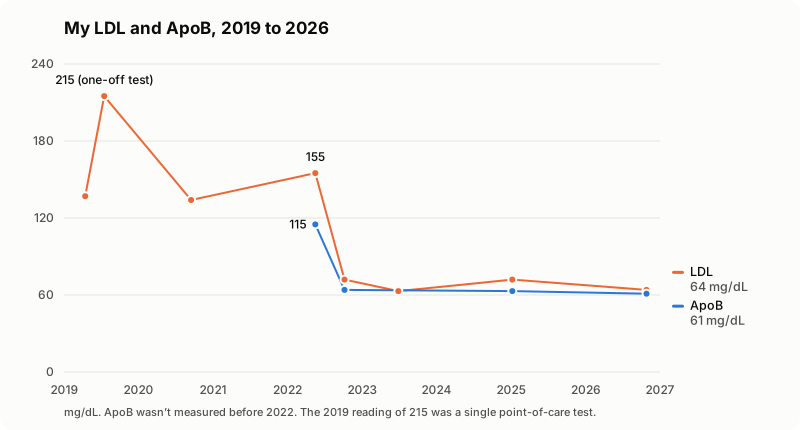
I have an extensive family history of heart disease and stroke, which is why I made going on a lipid-lowering medication a priority in my 20s. On top of that, my Lp(a) is high, and I carry one copy of APOE4, which tends to raise LDL and is the biggest common genetic risk factor for Alzheimer’s.
Treatment has cut my LDL roughly in half, to 64 mg/dL, and brought my ApoB down to 61, under my target of 70.
Test your Lp(a) once
Lp(a) is a separate risk factor for heart disease. It’s mostly genetic, so diet and exercise barely touch it, and you only need to test it once. About one in five people have high Lp(a), and most don’t know. I’m one of them, at 172 to 189 nmol/L, well above the high-risk cutoff of 125. Guidelines now say every adult should get tested, and it’s usually included in Superpower and Function Health panels.
There’s no great drug for it yet. The first Lp(a) drug to be fully tested didn’t significantly reduce heart attacks and strokes. If yours is high, the best move for now is to be extra aggressive on ApoB and blood pressure.
A calcium scan as a scoreboard
I got my first coronary artery calcium (CAC) scan at 30 and plan to repeat it every five years. It’s a quick, low-dose CT scan of your heart’s arteries, and my score was zero. I’d like to keep it that way as long as I possibly can. It only sees calcified plaque, and most people in their 30s score zero, but it’s a cheap baseline that gets more useful each time you repeat it. You can order one through your doctor.
Blood testing twice a year
I get extensive blood work twice a year, way more than a typical physical covers. A standard physical usually checks a basic cholesterol panel, blood sugar, and a blood count. Most doctors don’t order ApoB, Lp(a), homocysteine, fasting insulin, or omega-3 levels unless you ask, often because insurance won’t cover them, but those are the markers that catch problems early. ApoB, for example, is a more direct measure of heart disease risk than LDL.
That’s why I recommend Superpower or Function Health. Both test 100+ biomarkers, including all of those, without needing your own doctor to order them, and they catch things while they’re still easy to fix.
They also show you the level you should be aiming for on each marker, not just whether you’re outside the normal range. I take those targets seriously, and sometimes I go further than they recommend. I aim to keep my homocysteine under 10 µmol/L, for example, and my ApoB under 70 mg/dL rather than under 100.
Almost every supplement I take is there because a blood test told me to take it:
- Vitamin D. I’ve tested below optimal before, so I take Jarrow 2,500 IU vitamin D3 every morning. Supplementing has gotten me close to the 40 to 60 ng/mL range I aim for. If you already have enough, extra vitamin D doesn’t seem to do much.
- B12 and folate. My homocysteine came back at 10.9 µmol/L in my latest test, up from 9.3 the year before and above my target. High homocysteine is linked to heart disease, stroke, and dementia, and B vitamins have been shown to lower stroke risk and slow brain shrinkage in people with high levels, so I started taking Pure Encapsulations B12 Folate.
- Omega-3s. Mine were close but not quite optimal, so I take Viva Naturals 2.2 g fish oil. More isn’t automatically better, though, since very high doses are linked to atrial fibrillation.
That’s why it’s hard for me to recommend supplements in general. I try to get everything else from a healthy diet and only add a supplement when a test gives me a reason, then retest to make sure it worked. The exceptions are creatine and protein if you’re active.
Blood pressure at home
High blood pressure is the leading modifiable risk factor for death worldwide. It wears down your arteries, heart, kidneys, and brain, and it usually has no symptoms, so close to half of American adults have it and many don’t know. Bringing it down cuts heart problems and deaths by about a quarter. I aim to stay under 120/80, which is what the American Heart Association considers normal.
One reading a year at the doctor’s office isn’t enough, and it often isn’t even accurate. Offices tend to test you right after you sit down, sometimes while you’re still talking, and a lot of people get nervous being tested. That’s enough to push your numbers up, and it’s common enough to have a name: white coat hypertension.
So I test at home with a Withings upper-arm cuff. I sit still for five minutes first, with my back supported, feet flat, and arm at heart level, as the American Heart Association recommends. The cuff is accurate, the app is great, and it syncs to Apple Health. Whatever cuff you buy, make sure it’s been independently validated. My Apple Watch adds hypertension notifications as a safety net, but it misses more than half of people with high blood pressure, so the cuff is the real check.
Full-body MRIs
I get a full-body MRI every year to screen for cancer, and I think it’s one of the most underrated tools in longevity. Standard screenings only cover a handful of cancers. Many of the deadliest ones, like pancreatic, kidney, liver, and ovarian cancer, have no routine screening at all, so they’re usually found late. Stage makes an enormous difference: kidney cancer caught while it’s still localized has a 93% five-year survival rate, compared with 19% once it has spread.
The best options I’ve found are Prenuvo, at around $2,500, and Ezra, at $899 with a Function Health membership. Prices are falling fast, too. Most of the cost is the time you spend in the machine, and FDA-cleared AI has already cut Ezra’s scan from an hour to under 30 minutes. The company is aiming for a 15-minute, $500 scan next, which would make it worth it for a lot more people.
How often to scan depends on your age, since cancer rates climb steeply as you get older. Prenuvo’s guidance is every one to two years for younger, low-risk people and every year for most adults over 40 or anyone at higher risk.
Critics say these scans find harmless things that lead to more tests and anxiety, and there aren’t long-term trials yet. But your first scan becomes your baseline, and if something looks exactly the same a year later, it’s almost certainly nothing. MRI doesn’t use radiation either, and for me, catching one cancer early is worth a few false alarms. Just keep doing the standard screenings too, since an MRI doesn’t replace a colonoscopy, mammogram, or skin check.
Your genome and your family history
I had my whole genome sequenced through Genome Computer for $499 and wrote about analyzing it with AI. You only do it once, and you can keep asking it new questions as the science improves.
The most interesting part was how well it lined up with my blood work. It found a variant in the LPA gene linked to high Lp(a), and my Lp(a) genetic score came back in the 99.8th percentile. Blood tests had already shown that years earlier. It also found the genes for Gilbert’s syndrome, which I’d already been diagnosed with from blood work. Gilbert’s is harmless but matters for a few medications. Seeing my DNA confirm what my blood work had found made me trust the rest of the data more, even though a genome is less actionable than most of this list.
I also keep track of my family history: what my parents, siblings, aunts and uncles, and grandparents have dealt with, and when. It’s free, it catches risks genetic testing can’t explain yet, and it shapes what my doctor and I decide to screen for and when. My family’s history of heart disease and stroke is a big part of why I take ApoB so seriously.
Part two: The habits you already know matter
Exercise
If tirzepatide is the best longevity drug, exercise is the best longevity anything. It helps your heart, metabolism, brain, mood, sleep, and bones all at once.
The one number I’d care about is VO2 max, the most oxygen your body can use during hard exercise, and its link to lifespan is wild. The least fit people have about five times the risk of death of the fittest, which makes being unfit a bigger risk than smoking or diabetes. VO2 max drops roughly 10% per decade, so starting higher matters a lot later, when climbing stairs and carrying groceries start to depend on it.
Strength matters almost as much. Muscle protects you from falls and frailty, soaks up blood sugar, and is hard to rebuild once it’s gone, especially on a GLP-1. The two numbers I’d track are lean mass on a DEXA scan and your main lifts relative to your bodyweight, and you want both holding steady or going up as you age.
Here’s what I do:
- Cardio. I run in the mornings, mostly at an easy, conversational pace, plus some harder intervals to push my VO2 max up.
- Strength training a few times a week.
- Moving during the day. I try to walk a lot and not sit for hours at a time. I work at a Fully standing desk and switch between sitting and standing throughout the day.
I’m not perfect about consistency, and it’s something I’d like to get better at. I travel all the time for work, and travel tends to wreck my workout schedule. That’s a big part of why I picked running, even though it’s higher impact than cycling, swimming, or rowing. All I need is a pair of shoes, so I can do it anywhere.
If you’re starting from scratch, a simple week could look like this:
- Two or three easy, conversational cardio sessions of 30 to 45 minutes.
- One harder interval session, like four rounds of four minutes hard and three minutes easy.
- Two full-body strength sessions: squats, hinges like deadlifts, pushing, pulling, and carrying something heavy.
- Walking on most days. The benefits of daily steps level off somewhere between 6,000 and 10,000 depending on your age, so you don’t need to chase a huge number.
Most people don’t exercise anywhere close to that much, even though the official guidelines call for 150 to 300 minutes of moderate cardio a week plus strength training twice a week. If that’s you, adding more exercise is probably the single best thing you can do for your health and longevity.
Tracking it with my Apple Watch
I track my workouts on an Apple Watch Series 12. Its heart rate tracks really closely to my Polar H10 chest strap, the gold standard for accuracy, with a much better experience, and it estimates your VO2 max from outdoor walks and runs. A lab test will give you an exact number, but for watching the trend, the watch is amazing. VO2 max is the number I care about most, and I can check it every day for free.
Creatine and protein
These are the two supplements I’ll recommend to pretty much anyone who works out.
I take 5 g of Thorne creatine every morning in my coffee. It’s one of the most researched supplements there is. It helps build muscle and strength, it’s safe, there’s growing evidence it helps your brain too, and it’s cheap.
I drink a Naked Whey chocolate protein shake during or after lifting. Active people need more protein than the minimum daily allowance, about 1.2 to 2 g per kilogram of body weight a day, and a shake makes that easy.
Sleep
Regularly getting under seven hours is linked to heart disease, diabetes, obesity, depression, and dementia. Bad sleep also makes you hungrier, less likely to work out, and worse at making decisions, so it makes everything else harder.
Keep your bedroom dark, quiet, and cool, ideally around 65°F. For cool, I sleep on an Eight Sleep, which heats and cools each side of the bed through the night. It’s one of the most expensive things on this list, but it’s made a real difference, and my sleep data backs that up. For quiet, I run a Blueair HEPA air purifier next to my bed, which doubles as white noise and cleaner air. For dark, blackout curtains or a sleep mask are cheap and work.
Sleep tracking
I wear the same Apple Watch to bed every night. It tracks your sleep stages, gives you a sleep score, and watches for signs of sleep apnea, on top of the ECG app, irregular rhythm notifications, and hypertension notifications. Apple has put an enormous amount of R&D into these features, and I don’t think any other wearable comes close. I’ve owned an Oura Ring and a Whoop in the past. Oura is decent for sleep and Whoop is decent for workouts, but my opinion is that neither is as good as the Apple Watch overall. If you want to see how wearables actually compare, The Quantified Scientist on YouTube tests them against lab-grade equipment and is a great resource.
Magnesium before bed
I take 240 mg of Pure Encapsulations Magnesium Glycinate before bed, and I find it helps me sleep. About half of Americans don’t get enough magnesium, and standard blood tests miss it because most of it is stored in your cells and bones. The glycinate form also gives you a bit of glycine, an amino acid that extended lifespan in mice.
Diet
Even with tirzepatide, what I eat matters. I do almost all my shopping at the farmers market, avoid processed food, and eat close to a Mediterranean diet: lots of vegetables, fruit, beans, whole grains, nuts, olive oil, and fish.
It has some of the best evidence of any diet. It cuts heart attacks and strokes and lowers the risk of dying from any cause. Avoiding ultra-processed food matters too, since people eat about 500 more calories a day on it without trying.
I’m not perfect about any of this, and I’m OK with that. Being 100% strict doesn’t last for me. Eating well most of the time, with tirzepatide as the backstop, does.
I wore a continuous glucose monitor through Levels for about three months. It showed me what spiked my blood sugar, but nothing surprised me, and I don’t feel like I need one anymore. I keep a One Drop meter around for spot checks, but I hardly ever use it these days.
Smoking, nicotine, and alcohol
Not smoking is obviously the best thing you can do for your longevity. Smokers lose at least 10 years of life.
Nicotine by itself is a different story. It’s very addictive, but it isn’t what makes smoking deadly; the tar and other chemicals in the smoke are. On its own, nicotine doesn’t appear to be very harmful for adults, though it briefly raises your heart rate and blood pressure and is bad for teenagers and during pregnancy.
The news on alcohol is less fun: no amount appears to be good for you, and it causes several cancers. But the dose matters a lot, and if you’re moderate, I don’t think it’s a big deal. Just don’t think of it as a health food, and watch what it does to your sleep.
Mental health and relationships
I use Oak for meditation, and Breathe in Apple’s Mindfulness app for a quick reset during the day. Every so often I take the depression and anxiety questionnaires in Apple Health so I can track my mental health over time like everything else.
Relationships might be the most underrated part of longevity. People with strong social ties are about 50% more likely to survive over time, and loneliness carries a risk of early death comparable to smoking. It doesn’t cost anything to make plans with friends, call your family, or join something that meets regularly.
I don’t have a dog, but I think they’re great for longevity. Dog owners have about a 24% lower risk of dying from any cause. Some of that is probably healthier people getting dogs, but a dog gets you outside walking every day and cuts loneliness and stress.
Part three: The basics that are easy to skip
A primary care doctor, vaccines, and good insurance
A lot of this post needs a doctor, and the medications need a prescription. I see my primary care doctor every year for a checkup. I use One Medical and I’m a big fan. Booking is easy, it’s quick to get in, and I can message my care team from the app.
My checkup is also when I stay current on vaccines, like flu shots and tetanus boosters, with shingles to come at 50. They’re easy to skip, but they matter more as you age, and there’s even a surprising longevity angle: people who got the shingles vaccine were about 20% less likely to be diagnosed with dementia over the next seven years.
I’m in the US, so I also make sure I have good health insurance. I don’t expect to use it much, but a serious accident or diagnosis can cost hundreds of thousands of dollars. Know your out-of-pocket maximum, since that’s the number that matters when something big happens.
Standard cancer screenings
The standard screenings are boring, but they work. Colonoscopies find and remove polyps before they become cancer, and mammograms, cervical screening, and lung screening for longtime smokers catch cancer while it’s much more treatable.
Colon cancer rates have been rising in younger adults, the recommended age for a first screening dropped from 50 to 45, and I have a family history of colitis, Crohn’s disease, and colorectal cancer. So I plan to start screening at 40, possibly even 35. Colonoscopies carry a small risk of complications like a perforated bowel, and more of them means more risk, but for me the benefit of catching something early outweighs that. If you want to start early too, talk to your doctor, because insurance usually won’t cover a screening colonoscopy before 45 unless you have a family history or symptoms.
The dentist and the optometrist
These feel like chores, but they matter more than people think.
Close to half of American adults over 30 have some form of gum disease, and it’s linked to heart disease and stroke, diabetes, and even Alzheimer’s, likely through chronic inflammation. Cleanings remove the hardened plaque brushing can’t and catch gum disease while it’s still reversible. Most people should go every six months.
An eye exam can catch glaucoma, which takes your vision without symptoms. My dad has glaucoma, and my genome suggested I’m at higher risk for it too, so I don’t skip mine. It’s also the only place a doctor can see your blood vessels directly, so it can show early signs of diabetes and high blood pressure. Untreated vision loss is also a risk factor for dementia.
Your hearing
Hearing loss is the biggest modifiable risk factor for dementia, and it creeps up so slowly that most people don’t notice. Treating it seems to help, too, since hearing aids slowed cognitive decline in older adults at higher risk.
I already have very mild hearing loss in my left ear, which the hearing test on my AirPods Pro confirmed, so this is one I take seriously. If you have AirPods Pro, you can check your own hearing for free in about five minutes. The Hearing Test is clinically validated and saves your results to Apple Health, and if it finds mild to moderate hearing loss, the same AirPods can work as an FDA-authorized hearing aid. I think it’s one of the best health features Apple has shipped. Take it once for a baseline, then retest every year. And protect what you have: noise damage is permanent.
Sun protection
Skin cancer is the most common cancer in the US, and daily sunscreen cuts melanoma risk about in half while also slowing visible skin aging.
I use mineral sunscreens, which mostly sit on top of your skin. Common chemical filters get into your bloodstream at levels high enough that the FDA wants more safety data. That doesn’t mean they’re harmful, but mineral sunscreens sidestep the question. My picks are Pipette most days, Blue Lizard Sensitive for beach days, and EltaMD UV Clear for my face. EltaMD is technically a hybrid, but I use it because it leaves basically no white cast on my face, and that matters if I’m going to wear it every day.
The US went more than 20 years without approving a new sunscreen ingredient, but this year the FDA finally added bemotrizinol, which barely absorbs through your skin. I can’t wait to try it once sunscreens with it hit shelves.
Driving
Car crashes are a leading cause of death for people ages 1 to 54 in the US. I drive a Tesla Model Y, which gets top marks in crash testing, and I always wear my seatbelt, which cuts your risk of dying in a crash by about 45%. Put the phone away, don’t speed, and never drive after drinking.
Putting all the data in one place
All of this produces a lot of data, and it’s only useful if you look at it.
I sync everything I can to Apple Health: my watch, the Withings scale and cuff, and my workouts. Everything else, like blood test PDFs, scan reports, and my genome data, goes in a Health folder on my desktop.
ChatGPT Health can analyze everything in Apple Health, which is great for spotting trends. For deeper questions I use Claude Cowork working in my Health folder. That’s how I analyzed my genome, and it’s how I compare new blood work to my older results. Making sense of your own data used to mean hours of reading research papers, and now I can just ask questions in plain English against my own records.
What I’m not doing
People ask me about plenty of things that aren’t on my list. Here’s the short version on the most popular ones:
- Rapamycin. The most promising longevity drug I’m not taking yet. It’s the biggest success of the NIA’s Interventions Testing Program (ITP), which tests possible longevity drugs in genetically diverse mice at three labs at once. Rapamycin extended lifespan in both male and female mice, even when started late in life, and the ITP publishes everything else it’s tested if you’re curious. In people, low doses look reasonably safe, but we don’t know yet whether it slows aging. If you want to try it, Healthspan and AgelessRx can prescribe it. Just know it’s still an experiment.
- Regular sauna use. I use a sauna now and then, and I enjoy it. It helps me relax and sleep. But the longevity data is observational, and I’m not convinced it does much beyond what sweating through exercise already does.
- Cold plunges. There’s little evidence they help you live longer, and cold water right after lifting can blunt your strength and muscle gains.
- Fasting. I used to do a four-day, water-only fast every quarter. Now that I’m on tirzepatide, I think that’s too risky, and I’ve come to believe the muscle you lose outweighs the potential benefits of increased autophagy, which is hard to even measure in people.
- Biological age tests. Elysium Index, Tally Health, and GlycanAge are fun, but the epigenetic ones can swing by years between two runs of the same sample, and none of them tell you what to do. Your ApoB, blood pressure, VO2 max, and body composition already show how you’re aging, and you can act on them.
- NAD+ boosters. NR, NMN, and NAD+ IVs do raise NAD+, but NR didn’t extend lifespan in the ITP, and human trials haven’t shown much beyond a better number on a lab report.
- Peptides. GLP-1s are peptides too, so I think a lot could come out of this space. But it’s the total wild west right now, even for well-known ones like BPC-157. I’m holding off.
- Testosterone. It’s a growth signal, and growth signals are usually bad for longevity. If you’re clinically low, get treated. Mine is perfectly normal, and I see no reason to push it higher.
- Metformin. Its ITP results were weak, it may blunt the benefits of exercise, and I already take a GLP-1 with far more human data. I don’t want to double up on blood sugar drugs.
- Resveratrol. The red wine longevity molecule didn’t extend lifespan in the ITP, and human results have been disappointing.
- Other ITP drugs. Acarbose, 17-α-estradiol, and canagliflozin extended lifespan, mostly in male mice. None has been tested for aging in people, and two of them are diabetes drugs I’d be stacking on top of my GLP-1. Popular supplements like fisetin and alpha-ketoglutarate didn’t work in the ITP at all.
There are a million other things influencers and longevity people recommend, and I can’t go through all of them here. My approach to all of them is the same. I wait for strong human data, and I think hard about the risk and reward: the known and unknown benefits against the known and unknown risks. Something cheap and low-risk with a real upside, like creatine, is an easy yes. Something with unclear benefits and unclear long-term risks, like most peptides, can wait. For now, the boring stuff above has much better evidence.
What it all comes down to
Most of what matters is cheap or free. Back in 2023, I tweeted that everything I’d learned about longevity came down to four things, and I still stand by it:
- Exercise often. Cardio, lifting a couple of times a week, and more walking. Track your VO2 max.
- Eat real food. Something close to Mediterranean, without making yourself miserable.
- Get enough sleep. Dark, quiet, cool, and consistent.
- Be aggressive with preventative medicine. Get comprehensive blood work, including ApoB and Lp(a), and check your blood pressure at home. Talk to your doctor about your ApoB, blood pressure, and weight, since statins and GLP-1s are two of the most powerful tools we have. And keep up with the basics: a yearly checkup, cancer screenings, the dentist, eye exams, a hearing test, sunscreen, and vaccines.
Plus the obvious ones: don’t smoke, keep your drinking moderate, and wear your seatbelt.
None of this is as exciting as plasma transfusions or a hundred pills a day. But you don’t need $2 million a year. Most of the benefit comes from a handful of cheap, boring things done consistently for a long time.