 Will Hubbard
Personal AI agents at work
I’ve been using Claude Duet, ChatGPT Dots, and Grok Bot to help with my work at Agree.com and Adventure Fund. They’re the best personal AI agents I’ve found for work, and I’ve given them three jobs: chief of staff, customer success manager, and sales development representative.
They prepare me for meetings, investigate customer problems, track onboarding, and contact prospects. While I’m doing my own work, they can be reading a customer thread, checking a payment record, or putting together the next email. I still make most of the final calls. Much more of the legwork now happens before something reaches me.
I’m effectively writing job descriptions for software. And the more I use these agents, the more I think this is how most of us will eventually use AI: give it a responsibility, give it the tools, and let it get to work.
An agent that still has the job tomorrow
Most of my earlier use of AI depended on me remembering to ask. Open a chat, explain the situation, get an answer, carry it into the next app. Saved instructions helped, but I was still the person pushing the work along. If I forgot to follow up, the AI usually forgot with me.
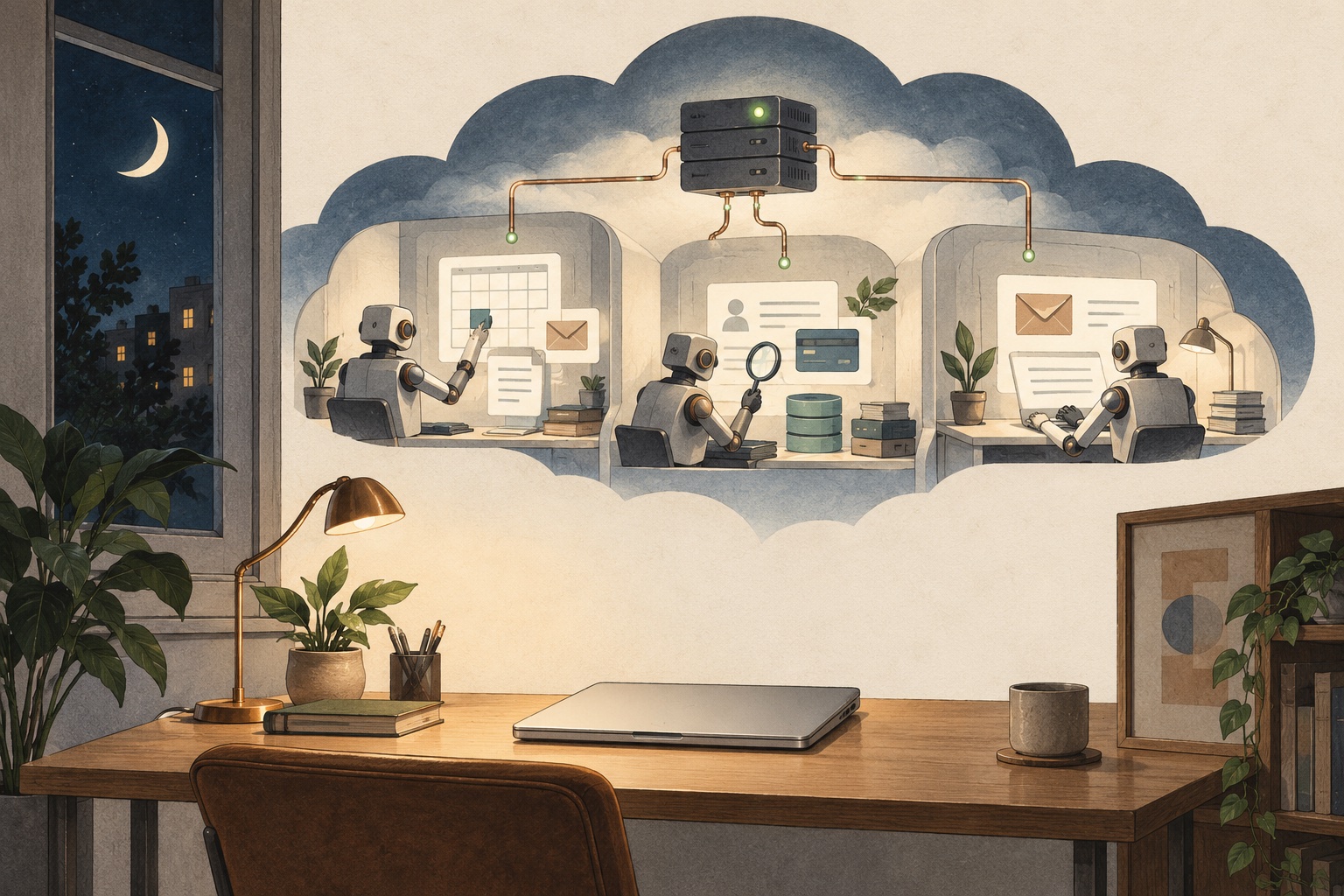
Personal agents change that relationship. The model has a persistent place to work: a computer in the cloud, with a browser, files, connected tools, and context it can return to. It can keep a task moving after I close the app, check back on a schedule, and bring me something when it needs a decision. That’s the approach behind products like Duet, ChatGPT Dots, and Grok Bot.
The virtual machine is the part I keep coming back to. A customer problem rarely fits neatly inside one chat. There’s an email, an investigation, a question for someone else, a wait, and then another reply. An agent needs somewhere to keep that work and a reason to come back to it. A persistent computer gives it both a workspace and a way to pick up again.
That lets me give it an ongoing job: “Help these customers get live.” “Keep finding good prospects for Agree.” “Make sure I’m prepared for the meetings that matter.” The agent has to work out the steps, keep the context, and return when there’s something worth bringing me.
An agent I’ve given a job needs to remember that it still has the job tomorrow. That’s a much higher bar than giving me a good answer once.
The personal agent landscape
I see two broad directions emerging. Duet, Dots, and Grok Bot are the ones I’ve found most useful for business. Products like Muse and Instinct feel more oriented toward consumers: helping with plans, errands, purchases, and the logistics of everyday life.
Muse emphasizes travel and personal goals through its app or WhatsApp. You can text or call Instinct to arrange groceries, train tickets, or flowers. There’s overlap, and I expect the boundary between work and life to keep moving.
The funny thing is that almost all of them have adopted a consumer interface. Whether I’m asking for groceries or a customer investigation, the experience largely feels like texting someone. That’s an easy way to get started. It gets less charming when three job functions are all sending me chat bubbles at once.
Claude Duet
Duet feels the most organized around the job of being an assistant. Separate channels report into one main channel, so I can keep different kinds of work apart. In a recent tweet, I described it as a hybrid of Slack and Grok Bot. That structure makes more sense as I give it more to do.
Its task list is a good idea that still needs work. Finished tasks stick around unless I tell it to clear them, and other tasks never make the list. If I have to remember what’s missing and what’s already done, I’m still maintaining a second list in my head.
The other tradeoff is how closely it shares context with regular Claude. My Duet instructions carry over, so preferences for a work assistant can blur into my personal use. And I’ve missed having an equivalent to Dots’ native desktop experience. Reviewing serious work from my phone gets old quickly.
ChatGPT Dots
Dots feels more consumer-oriented than Duet, but the desktop app keeps me coming back. An investigation or a long draft is much easier to review on the computer where I’m already working.
It also fits into the broader ChatGPT environment. Dots can use connected apps and delegate work to Work or Codex, which matters as the jobs I give it get more involved.
Organization is where it feels unfinished. Dots hasn’t given me Duet’s channels or a comparable task list in my setup. I ask it for one ranked action list across its responsibilities, which helps. But I still want to open the app and immediately see what’s waiting on me, what’s underway, and what’s done.
Grok Bot
Grok Bot leans furthest into the idea of an AI team. You can give different Bots different jobs, have them work in parallel, and let them hand work between themselves. They share a persistent cloud computer, including files and browser sessions. One can pick up where another left off. Here’s how that setup works.
Its access to X is another meaningful difference for what I want to do. It can search posts, read timelines, and check mentions. That gives it a natural place in the marketing workflow I want to build, where following conversations and figuring out what’s worth responding to is part of the job.
That’s how I think about the three right now: Duet for organizing work around a main assistant, Dots for fitting into how I already work on my desktop, and Grok Bot for building out a team of agents. I haven’t found one that gets everything right.
The interface still needs work
Duet and Dots both like to send a barrage of short messages. That’s manageable for one task. Once an agent is involved in several parts of my day, it can become overwhelming.
The models in both feel great, though it’s odd that I can’t choose which one I’m using. What I notice more often is everything around the model. Does this need me now? Could it wait for the afternoon brief? Has the agent finished, or has it just told me it’s going to start?
I don’t need another inbox full of updates. I need fewer things to keep in my head.
The jobs I’m handing over today
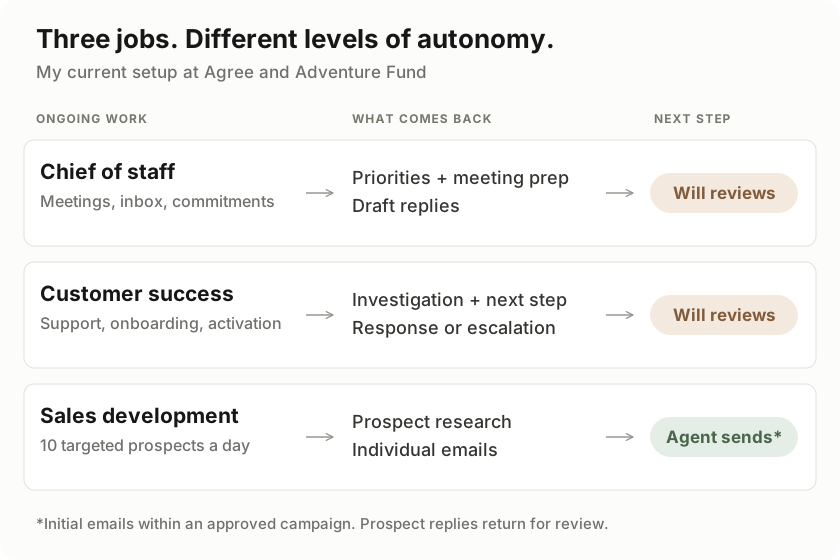
I’ve started with three functions that touch a large part of my day.
Much of the research and follow-up might otherwise go to an entry-level SDR, business development representative, or customer success hire. Other parts overlap with a chief of staff. Each role includes work an agent can increasingly take on from beginning to end.
I think this will replace substantial parts of those jobs, and sometimes the need to hire for a role at all. I’m already handing over work across all three, with different levels of independence for each.
Chief of staff
This role covers both Agree and Adventure Fund. I want it to know what I owe, what’s changed, and what needs my attention before I have to go looking.
Before a customer call, that means preparing the whole account: previous conversations, Granola notes, unresolved payments, onboarding problems, and promises we’ve made. A calendar summary isn’t enough. I want to know what to raise and what we need to leave the meeting having decided.
It also clears the junk out of my inbox and applies a label called Needs Will to the messages that need me. Where it can, there’s a reply ready in my voice. That label sounds simple, but it’s made my inbox much easier to manage. I can spend more time responding and less time sorting.
I’ve also asked it to maintain one ranked action list, with the three to five most important things I owe at the top of the morning brief. It needs to read sent replies and older threads so it doesn’t remind me to do something I’ve already done, or miss a promise just because the email is no longer unread.
Customer success manager
This is probably the most powerful role so far. A customer has a problem, and the agent can go find out what’s happening before I get involved.
When a customer emails us or posts in a shared Slack channel, the agent can pull together the conversation history, earlier Granola notes, and the relevant product and payment records. It has read access to our backend through Querio, plus payment context through Stripe and Whop where the connected tools have access.
The useful output is an investigation I can act on: what happened, what the records show, what might explain it, and what we should do next. I don’t have to open five different tools just to get oriented.
Sometimes the customer needs an explanation or a specific next step, and the agent drafts that response. Other times it looks like a bug, so it prepares a comprehensive escalation for our internal support or bugs channel, with the customer impact, relevant records, what’s been checked, and the help needed. I can then post that and create the Linear ticket.
The same role tracks onboarding and activation. I want it looking for signed customers who haven’t gone live, newly live customers who need help getting established, and customers whose activity has fallen off. It proposes useful check-ins over Slack or email, and I can hop on a call when that would help. It has my Cal.com links for scheduling.
A customer who never gets started may never file a support ticket. I want the agent watching those quiet accounts, too. The job is to help customers become healthy, repeat users of the product.
One rule I’ve added: a code change doesn’t mean the customer is fixed. Someone still needs to verify the result and tell them what happened. Over time, I want the agent to own more of that follow-through, from noticing the problem to checking that the customer got where they needed to go.
SDR and business development
The SDR role identifies ten highly relevant prospects each day, researches them, and writes an individual email to each one. We use Sprouts AI for enrichment, and the work syncs back to Lightfield, our CRM.
This campaign sends automatically, with my explicit approval to run it. Customer support and ordinary inbox replies still come to me as drafts. I’m comfortable giving different jobs different levels of independence.
Ten is deliberate. I want the agent to spend time on each person and write an email I’d actually send. I’ve found that much better than the automated sequences where “personalization” is a funding announcement pasted above the same pitch everyone else receives.
I’ve told it to avoid that formula: company fact, stock question, generic pitch. There needs to be a real reason to write, a useful point, and one clear next step. A weak reason to reach out doesn’t get better because the email sounds more human.
The role can also watch replies, distinguish interest from objections or referrals, and bring me substantive questions with a proposed answer. A human reply stops the no-response follow-ups, and a refusal ends the outreach.
I can see this expanding across the SDR or BDR function, from finding the right person to getting a useful conversation underway. An email sent, a meeting booked, and a meeting actually held are three different outcomes.
I still have to teach them how I work
“Be my chief of staff” leaves a remarkable amount open to interpretation. Which customer comes first? Who owns the next step? Does an acknowledgment count as finishing something? Teaching the agents my answers has taken a lot of time.
Voice has been especially revealing. An earlier analysis tried to learn how I write from outbound sales emails someone else had written under my name. The signature was mine. The writing wasn’t. Now I want it grounded in my actual Slack messages, genuine email correspondence, and my own spoken turns in Granola.
My edits matter more than generic copywriting advice. Sounding like me includes knowing what I wouldn’t say: a promise I can’t make, a claim I don’t believe, or a reason for reaching out that feels contrived. Making the sentences more casual won’t fix those things.
For most messages, I still review the draft and make the final call. If the results get good enough, I want to let it handle more replies automatically, as I already do with the approved prospecting campaign.
Then there’s “I’ll get back to you shortly.” Neither Duet nor Dots has been consistently good at following through on that kind of soft commitment. It’s a small sentence with a real obligation attached. I want the agent to remember the obligation long after the sentence has scrolled away.
I’ve also had to teach them when to leave me alone. Routine work belongs in the morning and afternoon reviews. Interruptions should earn their place. The test is whether I can hand over more work without spending more of my day managing the handoff.
Next up: marketing and engineering
The next role I want to build is a chief marketing officer. There’s plenty from my actual work that could be worth sharing. Turning it into something people want to read is a job of its own.
Grok Bot’s access to X makes it a natural place to try this. I’d like it to follow discussions relevant to Agree, Adventure Fund, or my personal interests, and bring me ideas I’d have something useful to say about. Then help draft the post. I want a similar process for LinkedIn, with my voice and my approval before anything goes out.
The bigger opportunity is connecting marketing to the rest of the business. The customer success agent knows what customers struggle with. The SDR knows which questions prospects ask. That’s useful material for deciding what to explain, write about, or show. I’d much rather start there than ask an AI to fill a posting calendar.
The other role is a software engineer working in the background. The customer success agent has already gathered the report and checked the account. I want an engineering agent to take that investigation, reproduce the bug, write a fix, run the tests, and open a pull request for review.
Feature requests could follow the same path. Feedback from Granola, Slack, and email becomes a proposed implementation, with an agent doing the work while I’m in meetings or asleep. I’d review a working proposal instead of starting by moving the request from one tool to another.
These are the next experiments; I haven’t replaced a CMO or an engineer. But I can see the chain: a customer reports a problem, one agent investigates, another proposes a fix, I review it, and the first agent follows up with the customer. Getting that whole chain to work is much more valuable than making any one step a little faster.
The tip of the iceberg
I think we’re moving toward a world where having a personal AI agent is as normal as having an email account. It will know what we’re working on, have access to the tools we’ve chosen, and keep certain responsibilities moving throughout the day. Opening the app will be a way to check in, give direction, or make a decision.
For a founder, that could change the shape of a company. Work that once required several early hires could be handled by a smaller team with agents doing much of the research, outreach, coordination, and implementation. Some of that will replace existing work. Some will make it practical to do things a company was too small or too busy to do before.
It changes what I’d pay for, too. A model can give a brilliant answer and still be a poor assistant. I’d value an agent that remembers an obligation, works across my tools, and knows when to involve me. Those are the qualities that make it possible to trust someone with a job.
A dedicated computer gives the agent somewhere to save the work, tools to keep going, and a reason to check back. My attention no longer has to be present for every step.
Today, I’m giving these agents three jobs and still supervising plenty of the details. I expect that list to grow. More of my work will become deciding what’s worth doing, teaching the agents what good looks like, and making the calls that need me.
Closing my laptop won’t mean the work stops. It’ll mean I’ve left it in someone else’s hands.