 Will Hubbard
The atavistic theory of cancer
I recently watched a video of breast cancer cells that I can’t stop thinking about. A friend of mine who images cells for a living showed it to me, and the cells didn’t look like they had random genetic mutations. They looked and behaved like a completely separate organism. Cancer cells crawl around, squeeze through tissue, climb on top of normal cells, outcompete their neighbors for food, and adapt when attacked. They’re human cells, but they act like microbes.
Around 400 BC, Hippocrates called tumors karkinos, which is Greek for crab (potentially because the swollen veins around a tumor looked like legs). The Romans translated that into cancer. Hippocrates never had a microscope, but a single cancer cell looks even more like a crab than a tumor does.
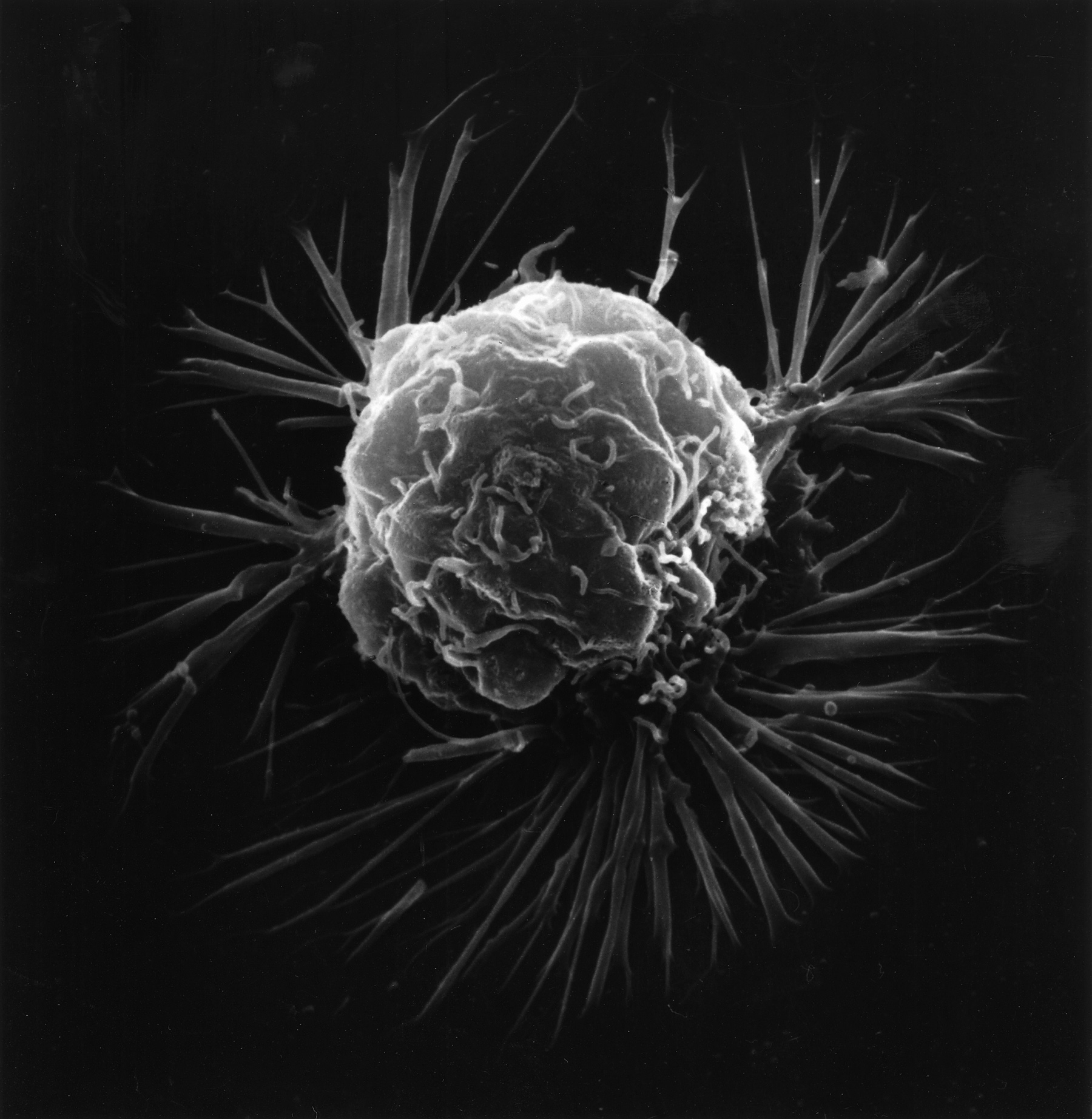 A breast cancer cell, seen through a scanning electron microscope.
Image: National Cancer Institute.
I spend a lot of time thinking about longevity. I’ve written about what I do for my health and what it costs and about sequencing my genome and analyzing it with AI. If you care about living longer, you have to care about cancer. That video sent me down a rabbit hole and landed me on an idea called the atavistic theory of cancer, which has completely reshaped how I think about the disease and about aging.
Cancer as an ancient form of life
The conventional view is that cancer is a genetic accident: random mutations break a cell and it starts behaving badly. The atavistic theory says the cells are actually falling back to an ancient way of living that existed long before complex multicellular life. Physicist Paul Davies and astrobiologist Charles Lineweaver proposed it in 2011 and nicknamed the tumor state “Metazoa 1.0.” The name refers to the first loose colonies of cells from around a billion years ago, which cooperated only a little and came before true animals.
Life was single-celled for billions of years before animals appeared. Those early cells had to divide fast, move around, survive with little oxygen, and burn sugar through glycolysis. Multicellularity just added a newer layer of genes on top that forces cells to cooperate. These genes included instructions to stop dividing when told to, die when damaged, specialize, and talk to each other.
The clearest example of that newer layer is a gene called p53, which is nicknamed the “guardian of the genome.” When a cell’s DNA gets damaged, p53 pauses division so the damage can be repaired. If it can’t be repaired, p53 tells the cell to kill itself for the good of the body. It goes back to some of the first animals. In sea anemones, a p53-like gene protects the germ line by killing off damaged reproductive cells, and in vertebrates p53 took on that same job for every cell in the body. If a cell loses p53, it loses one of its most important safeguards. p53 is the most frequently mutated gene in human cancer, and more than half of all tumors have a mutated copy.
When mutations or stress damage that newer layer, the old programs come back. That’s where a lot of cancer’s familiar traits come from, including unchecked growth, tolerance of low oxygen, the Warburg effect (i.e. a preference for glycolysis), and invasion and spread. All of these resemble how scientists think single-celled life behaved before multicellular life existed.
Evolution doesn’t delete, it switches off
Cells remembering an ancient set of instructions isn’t science fiction. It happens often enough in biology that it has a name.
An atavism is an ancestral trait that comes back after being absent for many generations. The word comes from the Latin atavus, literally meaning “great-great-great-grandfather.” The classic examples are:
- Human babies born with a small tail. Our ancestors had tails, and we still carry the genetic instructions for one.
- Whales or dolphins found with tiny hind legs, a leftover from their land-walking ancestors.
- Chickens with teeth. Birds lost their teeth over 70 million years ago, but certain mutations can partly bring back tooth development.
The old genetic programs of our ancestors are still there. They’re just switched off until something switches them back on. The atavistic theory says that cancer works the same way, except that the trait coming back is the single-celled way of living.
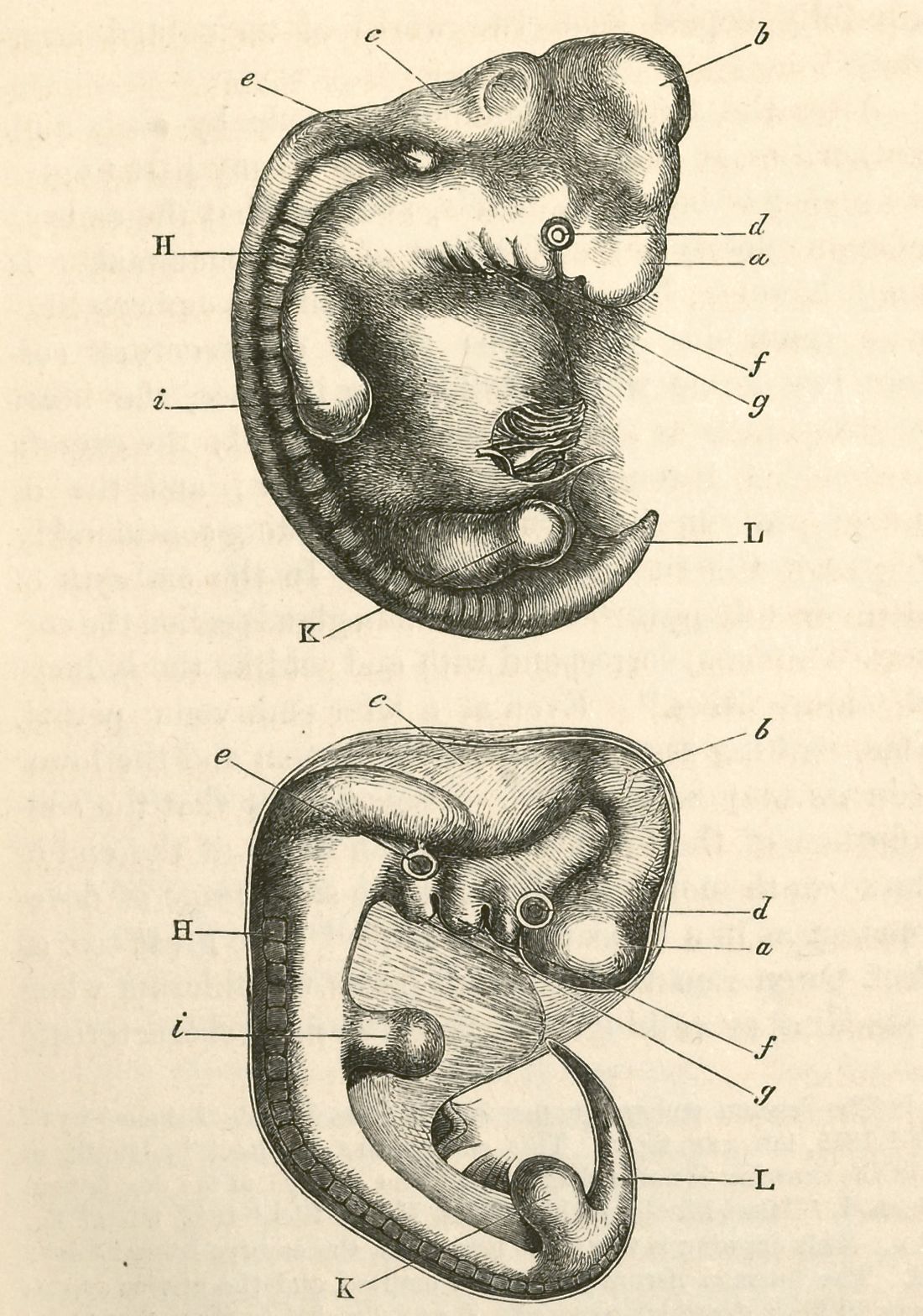 A human embryo (top) and a dog embryo (bottom), both with tails, from Charles Darwin’s The Descent of Man (1871). Image: U.S. National Library of Medicine.
The hallmarks of cancer
If the theory is right, cancer cells should behave a lot like single-celled life, and there’s a famous list of how cancer cells behave. In 2000, Douglas Hanahan and Robert Weinberg published The Hallmarks of Cancer (which became the most-cited paper ever published in the journal Cell). Cancer is more than 100 different diseases, and they set out to describe what every one of them has in common. Their answer was a short list of capabilities a cell needs to become a tumor:
- keep sending itself growth signals
- ignore signals to stop
- resist cell death
- divide indefinitely
- invade other tissue
- grow new blood vessels to feed itself
Later updates added reprogrammed metabolism, evading the immune system, and disrupted differentiation (meaning cells that stop staying specialized).
Their paper describes these as capabilities cancer cells acquire. That would mean more than 100 different diseases, each starting from its own random mutations, all end up with the same set of skills. The standard answer is natural selection inside the body, where the cells that divide fastest and resist death take over, so every tumor gets pushed toward the same traits. But if you read the list again with the atavistic theory in mind, it looks a lot like what free-living single cells do: divide without asking permission, don’t die on command, burn sugar fast, forget specialties, hide from predators (i.e. the immune system), and go wherever you want. The theory’s explanation is that cancer cells don’t have to learn any of this, because it’s what their ancestors did for billions of years. That would also explain why tumors pick up all of these skills so quickly. If each one had to evolve from scratch, you’d expect it to take a lot longer.
Cancer is as old as multicellular life
If tumors are falling back on an old program, the genes they switch on should be old ones. “Gene-age” studies (phylostratigraphy) date each gene by when it first evolved. Work by Anna Trigos and colleagues in 2017 found that tumors tend to switch on genes of single-celled origin and switch off genes from the multicellular era. Tumors also seem to break the regulatory links between those two groups of genes, and a 2019 follow-up found that the mutations driving cancer tend to land on exactly those linking genes. Cancer’s habit of raising its own mutation rate under stress also looks a lot like what bacteria do.
Cancer isn’t unique to humans or to modern life. You can even see it in the fossil record. A horned dinosaur called Centrosaurus, which lived about 76 million years ago, had a malignant bone cancer that doctors confirmed under the microscope. A 240-million-year-old ancestor of turtles had a bone tumor that looks almost exactly like the osteosarcomas people get today.
Complex multicellular life evolved independently at least seven times (in animals, fungi, plants, and algae) and a review of cancer across the tree of life found the same issue in every multicellular life form: cells that stop specializing and pile up into disorganized masses. Hydra, a tiny freshwater polyp from one of the oldest branches of the animal tree, gets tumors on its own. The first animals that ever existed already carried most of the genes that can cause cancer in humans. As far back as we can look, cancer shows up wherever cells live together as a body.
A predictable enemy
If tumors are reverting, they should be more predictable, since they can only fall back on tricks they already have. Instead of chasing every new mutation, treatment could go after the weak spots of that old way of living, like its low-oxygen metabolism, its stress responses, or features the immune system can recognize.
Plenty of scientists are skeptical of this view of cancer, and point out that not all cancers look like the same ancient organism and that cancers grow their own blood supply (which primitive multicellular life wouldn’t have needed to do). I think those are fair points, and my guess is that the theory is an important piece of the story and not all of it. Either way, it’s a new lens on a disease that’s still really hard for us to treat. We’ve made big strides on other diseases like heart disease and diabetes, but most of our progress on cancer has been incremental.
It also changes how I think about aging. Advancing age is the most important risk factor for cancer: incidence climbs from fewer than 26 cases per 100,000 people under 20 to more than 1,000 per 100,000 at 60 and up. The usual explanation is that more years means more mutations. Through the atavistic lens, those mutations are wearing down the locks that keep a very old program shut away. Animals that live a long time seem to have stronger locks. Elephants carry at least 20 copies of p53, the guardian gene from earlier (we only have one), and bowhead whales, which can live more than 200 years, repair DNA damage far better than we do.
To me, cancer feels less like a separate disease that shows up late in life and more like what aging looks like inside a single cell that stops following the rules. Every cell in your body is carrying around a billion-year-old survival program that never got deleted, and part of staying healthy is keeping it switched off.